Wavelength Care — Patient Journaling App
A local-first web and iOS app that helps patients prepare for appointments, take notes during them, and build a lasting record of their health journey.
Appointment Report: Structured Pre-Visit Reflection
01 The Challenge
Patients often intend to raise symptoms, ask questions, or mention changes during their appointments, but many of these concerns are forgotten in the moment. Visits are brief, and issues that accumulate between them frequently get lost. Even when something is discussed, it’s rarely remembered once you're out of the parking lot, so each new appointment often starts from scratch.
Wavelength Care was born from its founder’s own experience navigating the healthcare system. She developed a personal process for preparing for appointments—reflecting ahead of time on her goals, concerns, and specific questions—which transformed the quality of her conversations with physicians. Wavelength Care turns that process into a product.
There’s another challenge: a patient’s care is rarely overseen by just one person. Patients move among primary care physicians and specialists, each seeing only a part of the whole picture—none have the full story the patient has lived. By bringing a record of discussions, changes, and questions to each new specialist, patients become the vital link between providers, able to give a holistic account of their health rather than starting over every time. That continuity is at the heart of Wavelength Care.
Underlying all of this is a design challenge: managing your own health is already demanding, stressful, and overwhelming. Any tool meant to lighten that burden must be careful not to add to it. That set a high bar. The app had to be genuinely easy to use and fit seamlessly into a patient’s existing routine, rather than creating extra work.
02 Approach
The product isn't one experience — it's three, and each one carries different requirements. Before an appointment: sporadic, unhurried journaling that works as well on a laptop as on a phone. During it: fast, glanceable, one-handed — enough to pull up the notes, talk them through with the physician, and capture what's said. After: reflection while everything is still fresh, then a durable record to revisit weeks or months later.
That middle moment is a phone moment. Nobody is opening a browser tab mid-conversation with their doctor, and this sets the terms for everything else. The web app carries the full feature set; everything a patient can do on iOS, they can do on the web. But the design lineage runs in one direction: we designed for the phone first and adapted outward. Designing for the most constrained and most demanding context forced a clarity we could then carry to the larger screen, rather than designing something roomy and trying to compress it later.
A few of the decisions worth surfacing:
Structured Reflection
Give patients a blank page and most won't know where to start. Give them a rigid questionnaire and it stops reflecting what's actually on their mind. We landed on a mix of categories — goals, primary concerns, changes since last visit, recent symptoms, general concerns, and questions — that guide reflection while leaving the writing entirely open-ended.
Local-First by Principle
Connectivity inside medical buildings is unreliable, and the app has to work at exactly the moment it's least likely to have a signal. Built local-first on PowerSync and SQLite, Wavelength Care functions fully offline, with nothing standing between a patient and their own record. Cloud sync is optional, with end-to-end encryption so no PHI is ever accessible to us.
Native iOS, Not Cross-Platform
We chose Swift and SwiftUI over a cross-platform framework. Given how much of the product's value lives in that in-appointment moment, the responsiveness and platform-native feel of the interaction mattered more than the efficiency of a shared codebase.
Scoping for Now and Later
The MVP covers the complete appointment loop: enter an upcoming appointment, fill out a report ahead of it, take notes live, reflect afterward, then review past appointments when preparing for the next one. Deferred to later phases: vector search and AI features to summarize past visits, surface connections across them, and generate personalized questions — plus an Android app.
"Design for the hardest moment — least time, least attention, least signal — and everything else gets easier."
03 The Work
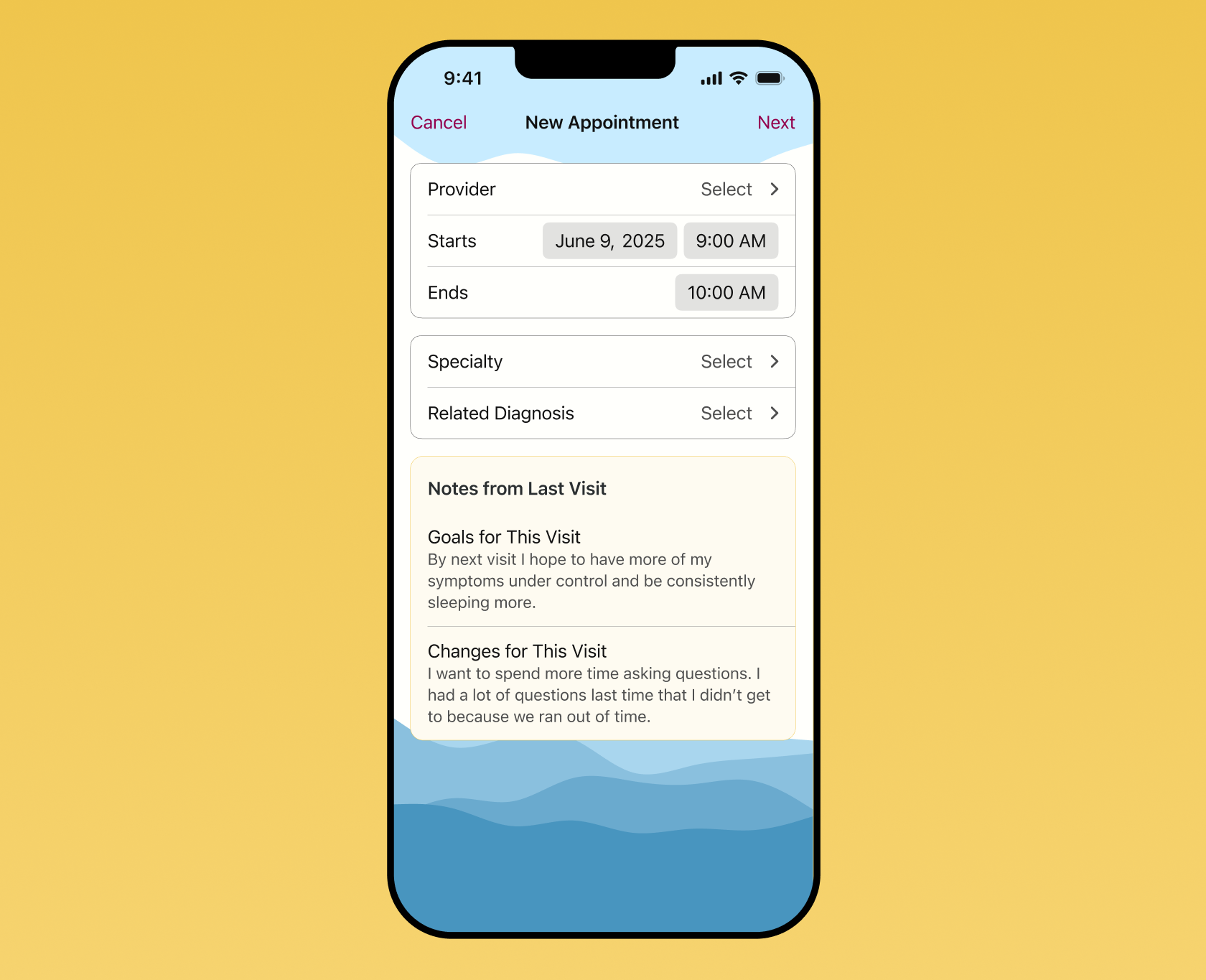
Adding an Upcoming Appointment
Everything starts with a date on the calendar. A patient enters an upcoming appointment, indicating who they're seeing and when, and that becomes the anchor for the preparation that follows. Keeping this step minimal was intentional: the goal is to get a patient into the journal work with as little setup friction as possible.
Creating an Appointment Report
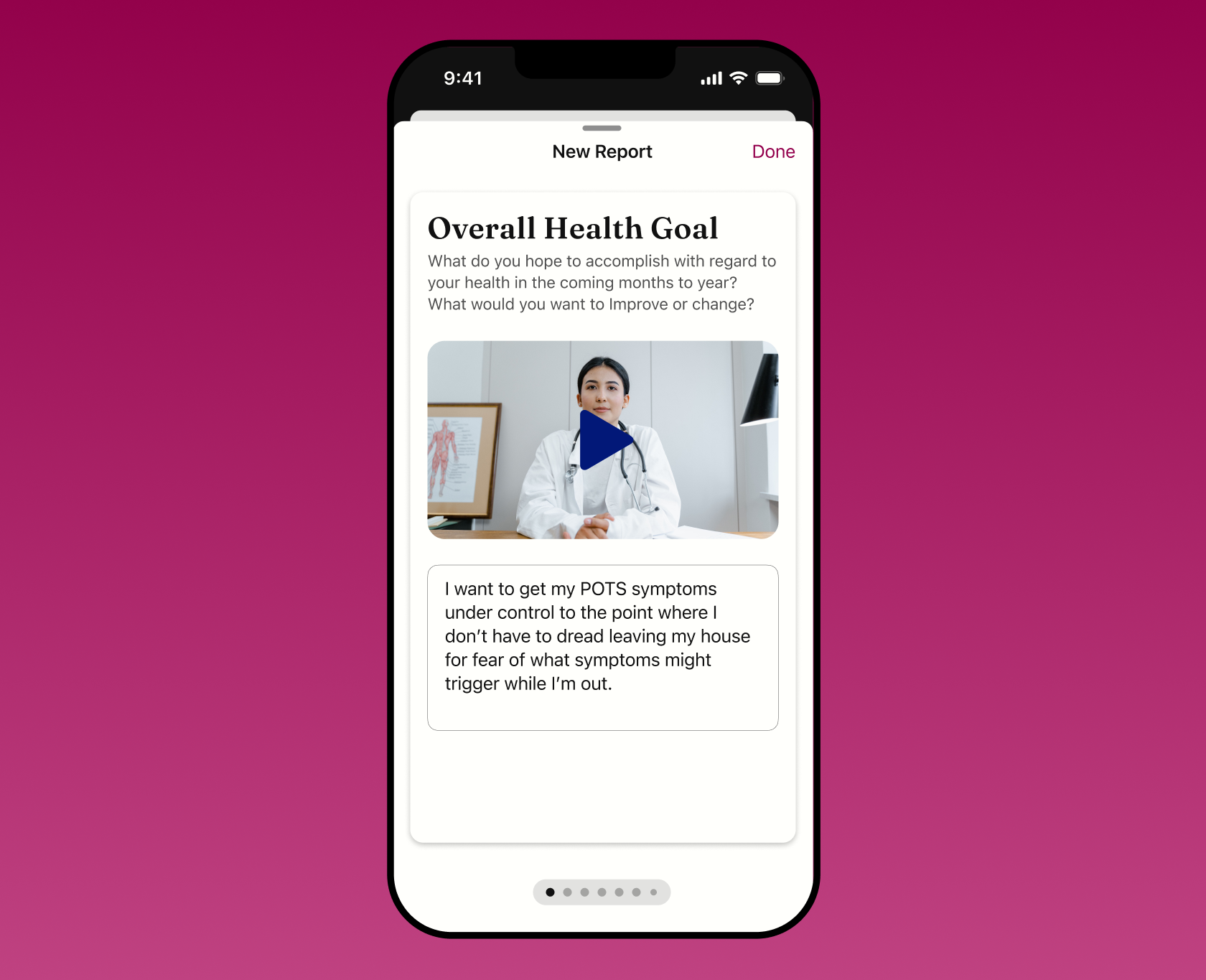
This is where the preparation happens. The report guides a patient through different categories of reflection including goals, primary concerns, changes since last visit, recent symptoms, general concerns, and questions. Each section is open-ended enough to hold whatever they actually want to say. The structure answers the blank-page problem without turning a personal reflection into a form to fill out.
Taking Notes During the Visit
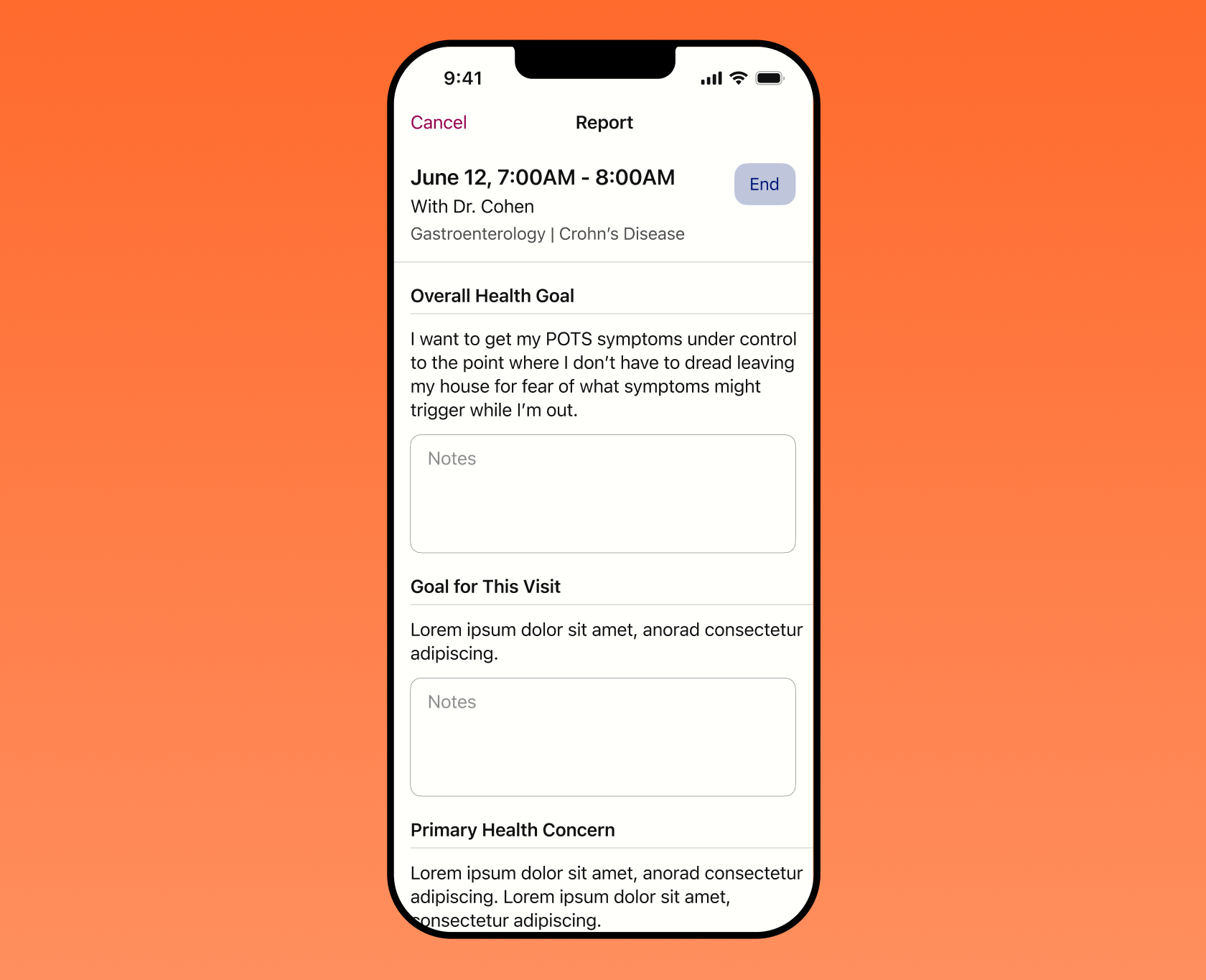
When the visit begins, the report becomes a live reference. A patient can walk their physician through what they came in to discuss and capture what's said as the conversation happens. This screen was designed for the hardest context the product operates in: one hand, limited attention, no reliable signal. It's fast, glanceable, and works entirely offline.
Completing a Reflection
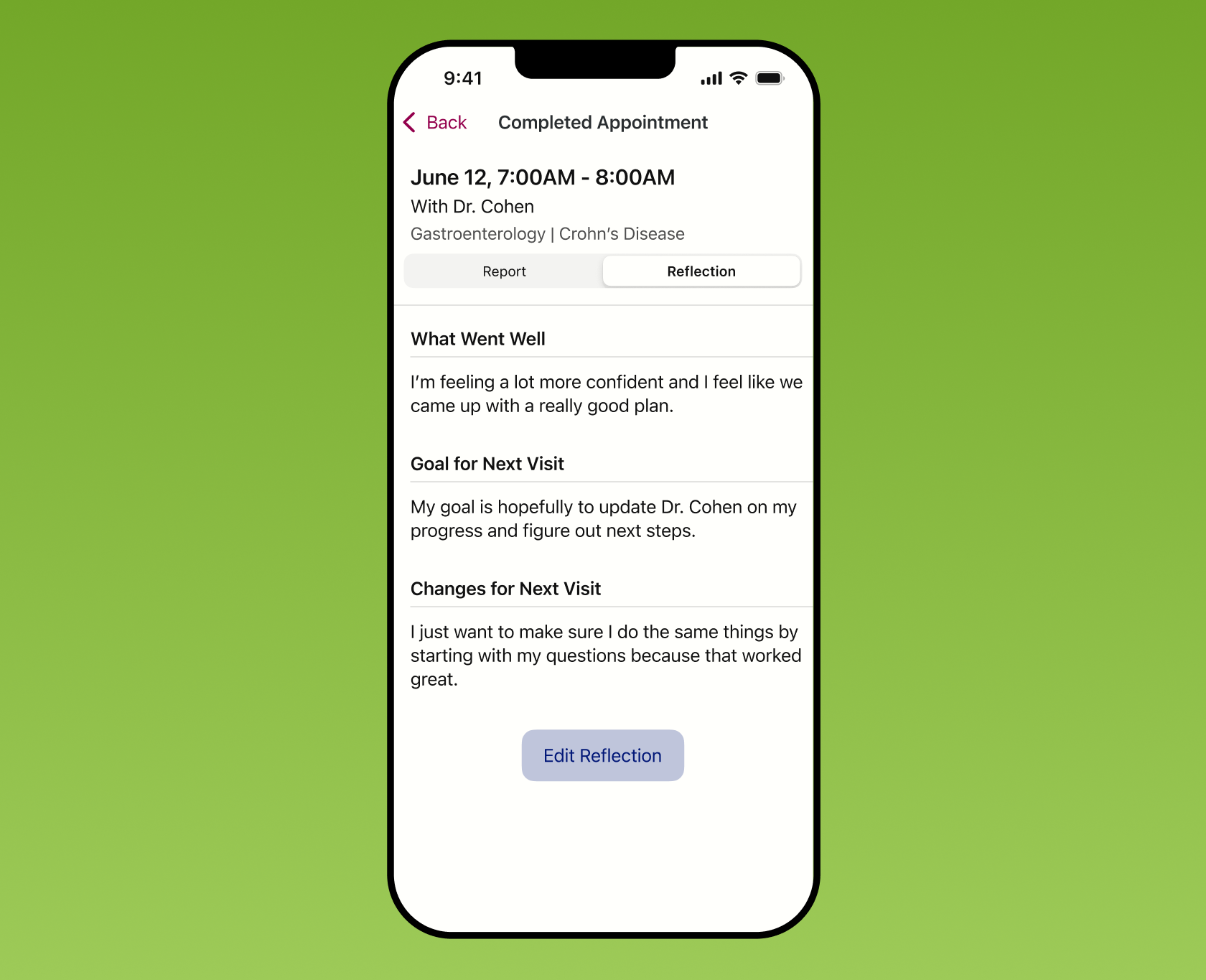
Directly after the appointment, while everything is still fresh, a patient reflects on what was covered and what comes next. This closes the loop and does the quiet work of turning a set of in-the-moment notes into something legible months later — which is what makes the historical record actually useful rather than just archived.
Reviewing Past Appointments
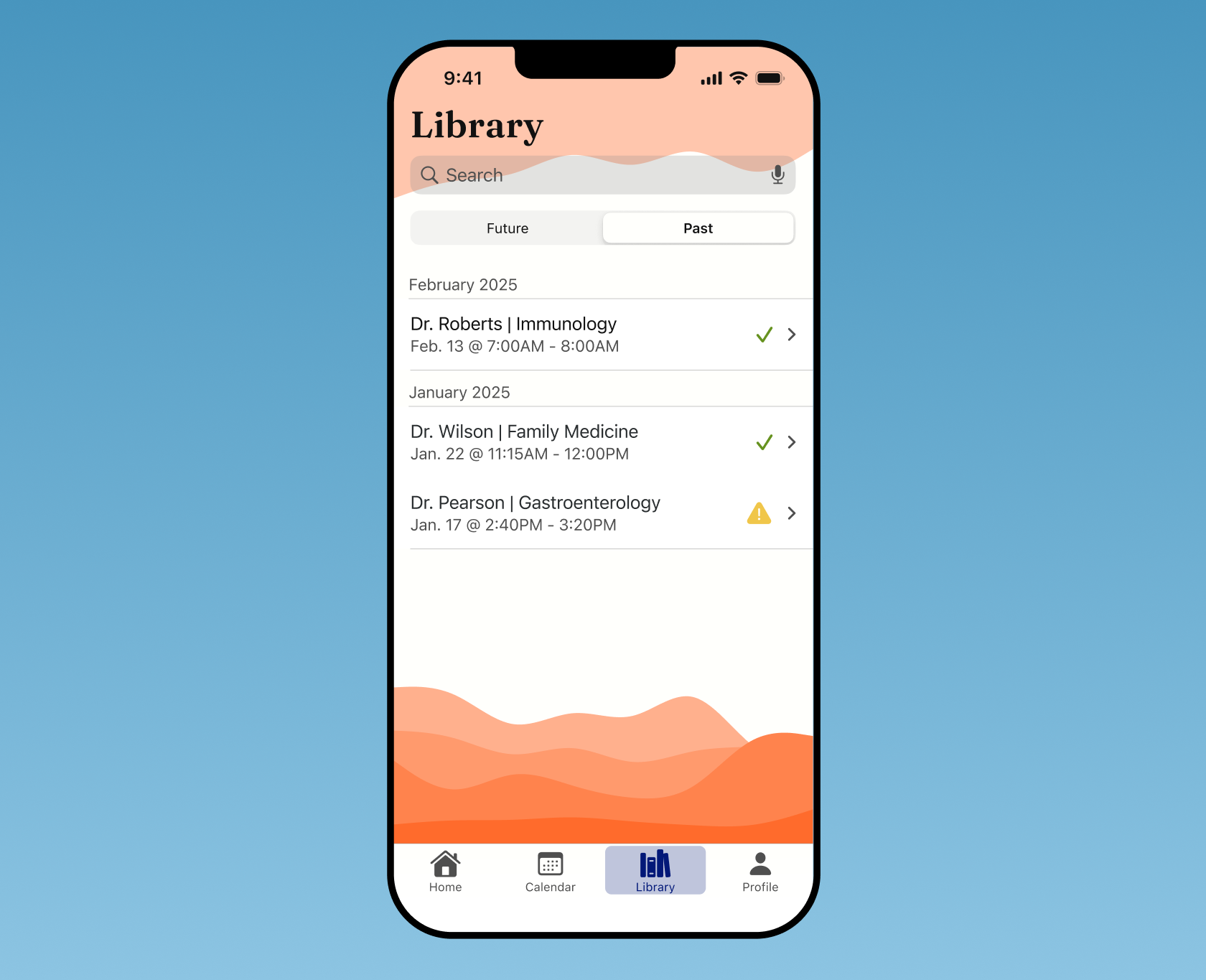
Past appointments become a durable record a patient can return to in the weeks after a visit to remember what they agreed to, before the next one to prepare with real continuity, or when meeting a new specialist who needs the fuller picture. This is where individual reports stop being separate documents and start being a health history.
04 Current State
The web beta is built and in active beta testing with users, while iOS development is underway. Later phases will bring AI-assisted summarization and connection-finding across a patient's appointment history, plus an Android app.
The founder describes the work this way:
"Ryan and Avintha helped turn Wavelength Care from an early idea into a working product that helps patients take control of their healthcare. Their approach is thoughtful, consistent, and collaborative. They're great communicators who make complex technical work easy for me (a non-technical founder) to understand."
Reflection
Local-first wasn't just a workaround for bad hospital wifi, it followed from what we were trying to build. If the goal is for a patient to walk into a room with confidence and a sense of control over their own care, then their notes can't be contingent on a signal bar or a loading spinner. The data is theirs; it should be on their device, available the moment they reach for it.
Once we understood offline access as a requirement of patient empowerment rather than a technical edge case, a lot of other decisions like end-to-end encryption, what we store, and what we're able to see followed naturally from the same principle.